
Retrieved from https://thesocialgrabber.com/brand-archetype-wheel/
In the past, I have written a couple blogs regarding Maya Angelou’s novel I Know Where the Caged Bird Sings. As you know, I have thoroughly enjoyed it, and so far I have delved into the novel from a Reader Response point of view and an Archetypal Literary point of view. Today, I will be analyzing the novel from an Archetypal Literary Theory perspective again! You might ask why? Well, simply, it is the most effective and valuable analysis technique for this novel.
Retrieved from https://giphy.com/gifs/tennis-novak-slams-auSIV7EQ2Gxb2
To recap what has happened since the last time: Maya graduates from the eighth grade, Maya experiences an excruciating toothache, they move back to California, Maya moves in with Bailey and his girlfriend, Maya overcomes several obstacles, and Maya gets pregnant.
Now, for those of you who do not know what archetypal literary theory is, it is defined as “the unknowable basic forms personified or concretized in recurring images, symbols, or patterns” (Delahoyde). These images, symbols, and patterns are very prominent in I Know Why The Caged Bird Sings and certainly helped me gain a greater understanding of the book.
In my previous post, I talked about how Maya follows the archetype of a hero and Momma is the great mother. I also spoke about the prominence of the colour black. Since then, I read the final third of the novel and then carefully reflected on the novel in its entirety, and I noticed a few more archetypal themes, figures, and symbols.

Retrieved from https://clipartstation.com/journey-clipart-7/
Overall, the book follows one of the fundamental plot archetypes, The Journey. The Journey can be broken down into 5 parts, the protagonist moves from innocence to experience, begins in a familiar environment, descent into danger, battle “monsters”, and returns home (ENG4UV, 2019). The protagonist in this novel is obviously Maya, who we establish to be the hero, and her life follows this journey quite well. She begins her life in Stamps, which is where she feels is home (Angelou, 58). Maya’s descent into danger is when Mr. Freeman rapes her (Angelou, 73). The battling of “monsters” is when she musters up the courage to convict Mr. Freeman (Angelou, 85). Finally, she returns home to Stamps and is proud of her accomplishments. Overall, she undoubtedly grows from a little girl from Stamps, to a young, mature woman. This journey shows the critical moments in Maya’s childhood and how they impacted her. It allows us to understand how and why she changed during the novel.

Retrieved from https://www.newsnation.in/article/94784-castration-child-rapists-suggest-madras-hc-centre-.html
As I mentioned, I have already written about Maya and Momma’s archetypal characters, The Hero and The Caregiver/The Great Mother, respectively. There is still one more archetypal character I want to talk about, The Villain. In this novel, Mr. Freeman appears to be the villain. He is the individual who presents the biggest obstacle for Maya, our hero. He rapes her, but Maya still has a soft side for him, thus giving her a barrage of mixed emotions. Once she is able to convict Mr. Freeman and overcome her silence, she becomes a different person. She becomes quite courageous and does various activities that show her physical and psychological development. This includes driving a car down a mountain in Mexico and living alone for 2 months (Angelou). It is almost as though Mr. Freeman made her stronger. I would absolutely not want anyone to be raped, but in Maya’s case, it allowed her to mature and grow up faster, which is interesting.
Retrieved from https://www.amazon.ca/Know-Why-Caged-Bird-Sings/dp/0345514408
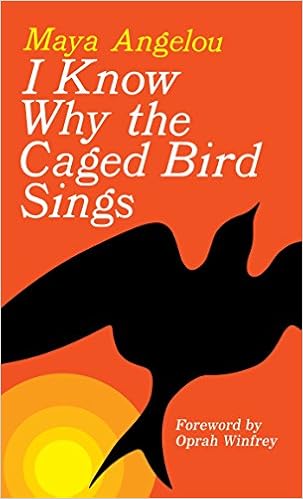
Another symbol that is prevalent in the novel and embodies Maya’s growth well is the sun. The sun provides healing, authority, glory, and warmth (Tomlin). The sun is located on the cover of the book for a reason, it is very vital in Maya’s growth as a person. It allows her to get over challenging obstacles, overcome various setbacks, and achieve stability. Although the sun does not actually come out of the sky and help her, it’s traits represent her journey very effectively.
One connection that I made while I was finishing up the novel was regarding the “relationship” between Maya and Mr. Freeman. Their struggle is similar to Harry and Lord Voldemort in Harry Potter. They are similar because the villain’s actions attempt to counter the hero’s actions. In both scenarios, the hero eventually overcomes the villain and puts them away, whether that be through killing them or putting them in jail.

Retrieved from https://www.slashfilm.com/olly-moss-harry-potter-book-covers/
Once again, I strongly recommend this novel for anyone who is looking for a good novel. It provides life lessons while also incorporating some history into it. It is non-fiction and in fact an autobiography, but it is written exquisitely. As usual, let’s continue the discussion in the comments and let me know if I missed anything! See you all later!
Retrieved from https://www.youtube.com/watch?v=TZoyGDHn8q0
Works Cited
Angelou, Maya. I Know Why the Caged Bird Sings: Regular Print Book Discussion Kit. Assembled by the Henderson County Public Library, 2016.
“Archetype Examples and Definition.” Literary Devices, 31 Oct. 2015, http://www.literarydevices.com/archetype/.
climbthestacks. YouTube, YouTube, 12 Nov. 2014, http://www.youtube.com/watch?v=TZoyGDHn8q0.
Delahoyde, Michael. “Archetypal Criticism.” Archetypal Criticism, public.wsu.edu/~delahoyd/archetypal.crit.html.
Tomlin, Brian. “The Sun Archetype: the Source of Creative Energy • Brian Beholds.” Brian Beholds, 9 Oct. 2018, brianbeholds.com/sun-archetype/.
 Rishi's Blog